
Educational Technology Market Research Report (2025)
Phygital (Physical + Digital) Education: The Next Frontier in EdTech Innovation
EdTech Research Lab
Executive Summary
The global educational technology (EdTech) sector is undergoing a significant transformation, driven by advances in artificial intelligence (AI), hybrid learning models, immersive technologies, and centralized management systems.
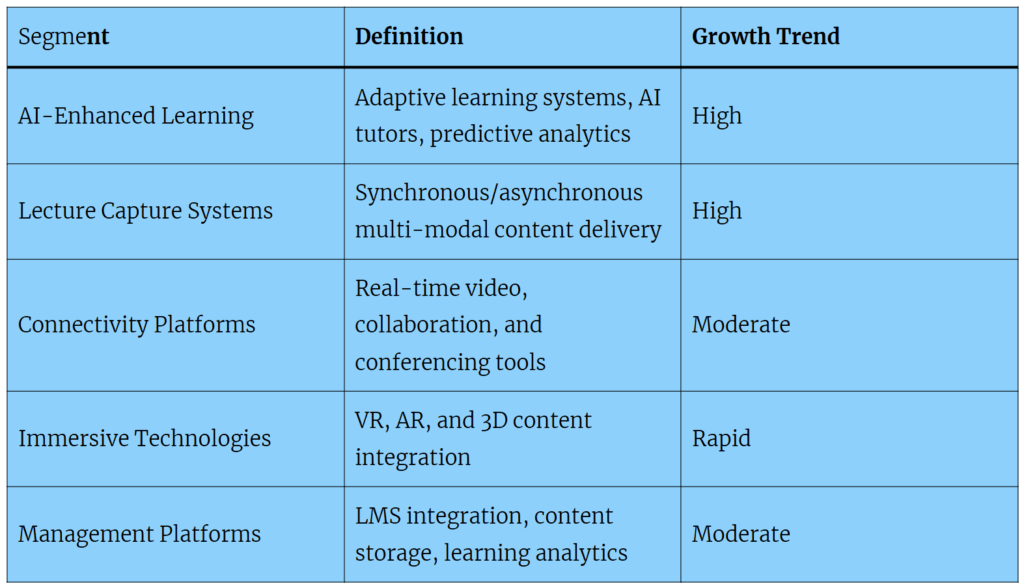
This report provides a comprehensive analysis of five key EdTech segments:
- AI-enhanced learning
- Lecture capture systems
- Connectivity platforms
- Immersive 3D and AR/VR technologies
- Comprehensive management platforms
It also features a competitive evaluation, highlighting HybriU — the first AI-powered Phygital (Physical + Digital) platform that seamlessly integrates physical and digital learning environments. HybriU consolidates all five functions into a single, unified solution, offering a more scalable, efficient, and engaging alternative to traditional, segmented EdTech ecosystems.
Research Objectives
- Examine the current landscape of AI-driven educational technologies
- Evaluate key players across major EdTech segments
- Identify emerging trends, opportunities, and barriers in immersive and AI-based learning
- Analyze the advantages of integrated Phygital platforms like HybriU over conventional solutions
Methodology
- Primary Research: Interviews with EdTech providers, CTOs of academic institutions, and AI researchers
- Secondary Research: Review of industry reports, patents, academic literature, and product release data
- Comparative Analysis: Assessment of scalability, feature sets, cost structures, and innovation across leading platforms
Market Overview
Market Size and Growth
The global AI-driven EdTech market is projected to reach $50 billion by 2030, with a CAGR of 18.2%. Key growth drivers include:
- Increasing demand for personalized, adaptive learning
- Expansion of hybrid and remote learning formats
- Growing investment in immersive VR/AR technologies
- Rising need for scalable, centralized education infrastructure
Key Segments and Growth Trends
Competitive Landscape
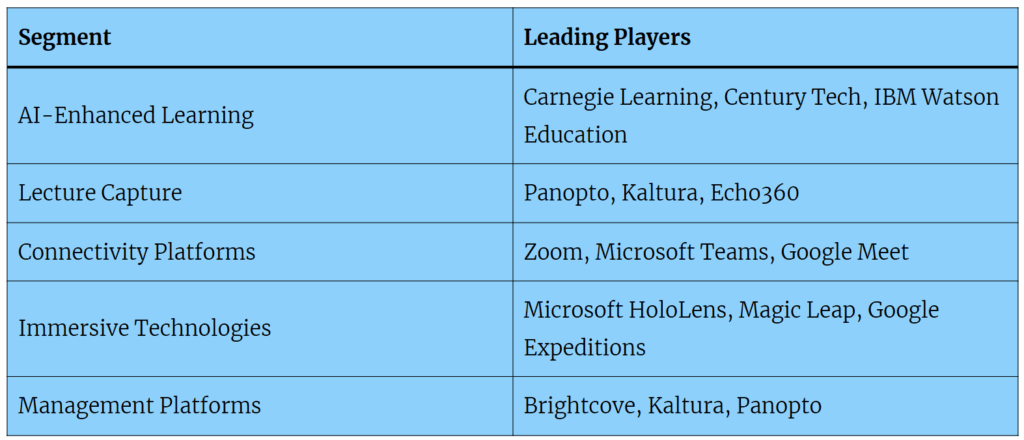
Historically, institutions have relied on multiple vendors, resulting in fragmented solutions, integration challenges, and elevated operational costs.
Comparative Analysis: HybriU vs. Traditional Multi-Vendor Solutions
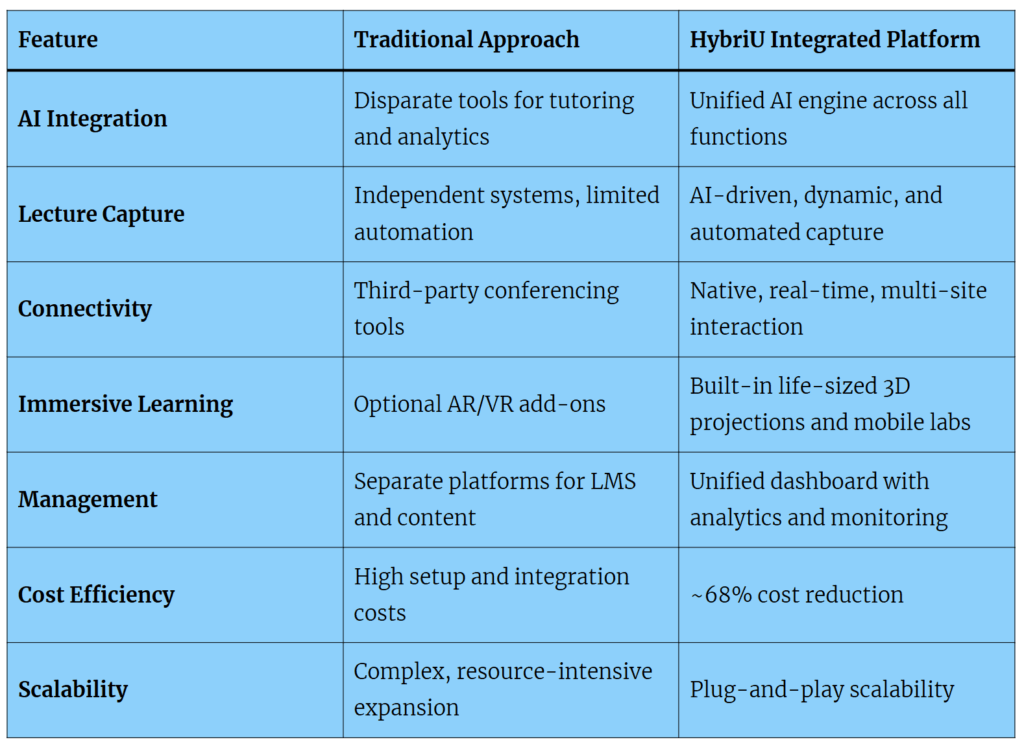
Key Differentiator: HybriU’s Phygital Innovation
HybriU is the first EdTech platform to fully integrate:
- A patented (2014) adaptive AI engine for real-time, personalized learning
- Automated lecture capture and native hybrid communication tools
- End-to-end immersive 3D technologies, including:
- Life-sized instructor projections
- Remote 3D learning labs
- Mobile 3D teaching carts
This convergence enables institutions to merge physical and digital education seamlessly — creating truly immersive, interactive, and scalable learning environments.
Cost Analysis
Traditional Segmented Systems:
- Setup: $50,000 – $150,000+
- Annual Maintenance: $15,000 – $50,000+
HybriU Integrated Platform:
- Setup Costs: 30–40% lower
- Annual Costs: ~68% lower
Primary Savings Drivers:
- Single vendor and platform
- Streamlined integration
- Centralized analytics and support
Forecast and Outlook (2025–2030)
- AI-powered Phygital platforms are expected to become the standard in EdTech by 2030
- Immersive 3D learning (life-size projections, mobile labs) will see widespread adoption in STEM and professional education
- Institutions will increasingly prioritize integrated, full-stack solutions over multi-vendor architectures
- HybriU is projected to capture 15–20% of the hybrid education market within five years, supported by global expansion efforts
Conclusion
EdTech stands at the threshold of its next evolution. The future of education is Phygital — removing barriers between physical and virtual, academic and industrial, local and global.
HybriU brings this vision to life. As the first fully integrated, AI-powered Phygital platform, it delivers a scalable, cost-effective, and personalized model for next-generation education.
Institutions that embrace this paradigm will be better equipped to enhance engagement, improve outcomes, and prepare learners for the challenges of a globally connected world.
Copyright © EdTech Research Lab